Fall Lake campgrounds near Ely
Facts checked against official sources on November 26, 2026
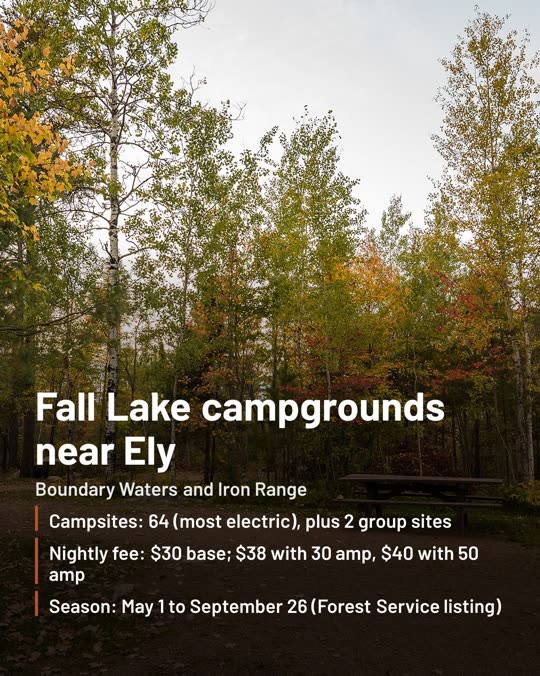
Photo: Tony Webster, CC BY-SA 2.0, via Wikimedia Commons
At a glance
- Campsites
- 64 (most electric), plus 2 group sites
- Nightly fee
- $30 base; $38 with 30 amp, $40 with 50 amp
- Season
- May 1 to September 26 (Forest Service listing)
- Booking
- Some sites on Recreation.gov, 6-month window; some first come
- Distance from Ely
- About 6 miles east
- Boundary Waters
- Part of Fall Lake north of camp is in the BWCAW (entry point 24)
In this guide
Fall Lake Campground is a Superior National Forest campground about 6 miles east of Ely with 64 campsites, most with electric hookups, plus 2 group sites. A single site costs $30 a night, with $8 extra for 30-amp power and $10 extra for 50-amp. It is open May 1 to September 26, and some sites can be reserved on Recreation.gov while the rest are first come, first served. Three smaller Forest Service campgrounds around Ely (Fenske Lake, South Kawishiwi River and Birch Lake) run $21 to $32 a night; Fenske Lake and South Kawishiwi River are open May 5 to September 26.
As of late November 2026 the Forest Service lists Fall Lake as "Closed–No fees or services (gated)," and Fenske Lake and South Kawishiwi River as closed with no fees or services.
Fall Lake sits on a 2,258-acre lake, and the part of the lake north of the campground lies inside the Boundary Waters Canoe Area Wilderness, so you can launch a canoe or a motorboat from camp. The Forest Service says the campground "opens in early May in time for walleye fishing season, making it a popular place for anglers." The other three are smaller and cheaper, with vault toilets.
Ely-area Forest Service campgrounds compared
| Campground | Where | Sites | Nightly fee (Recreation.gov) | Season | Showers and power |
|---|---|---|---|---|---|
| Fall Lake | About 6 miles east of Ely | 64, plus 2 group sites | $30 standard; $38 30-amp; $40 50-amp; group $110 or $130 | May 1 to Sept. 26 | Flush toilets and showers; most sites electric |
| Fenske Lake | About 10 miles north of Ely on the Echo Trail | 16 listed on Recreation.gov, including 5 walk-to and 1 group site | $22; group $65 | May 5 to Sept. 26 | Vault toilets; no electric sites on Recreation.gov |
| South Kawishiwi River | About 10 miles south of Ely off Highway 1 | 31; Forest Service says 14 electric, Recreation.gov lists 23 electric | $22 non-electric; $30 or $32 electric; pavilion $170 a day | May 5 to Sept. 26 | Vault toilets; some electric |
| Birch Lake | About 13 miles from Ely, off Highway 1 and Forest Road 429 | 29 standard sites, 2 camper cabins, 1 group site on Recreation.gov | $21; cabins $95; group $65 | See Recreation.gov | Vault toilets; hand pump; no electric |
Fees are from Recreation.gov as of November 2026 and may change for 2027.
Fall Lake Campground in detail
Sites and fees
The Forest Service Fall Lake page lists 64 campsites, "most with electrical hookups," and 2 group sites south of the campground on Fall Lake Road, which "have cook shelters and docks." Recreation.gov shows 62 reservable sites: 50 standard electric sites, 10 tent-only sites and the 2 group sites.
| Site type | Fee per night |
|---|---|
| Single site | $30 |
| Single site with 30-amp power | $38 ($30 plus $8) |
| Single site with 50-amp power | $40 ($30 plus $10) |
| Group site, up to 20 people | $110 |
| Group site, up to 30 people (or electric) | $130 |
| Extra vehicle | $8 |
Recreation.gov notes that tent-only sites 26, 33 and 41 have no electric hookup, and that sites 5, 10, 15, 16, 18 and 62 offer 20, 30 and 50-amp service.
Getting there
The Forest Service directions: go east from Ely 4.5 miles (Highway 169 becomes County Road 18), turn left on County Road 182 and continue 1.5 miles. Recreation.gov gives slightly longer numbers: 6.5 miles past Ely to County Road 182 (Fall Lake Road), then 2 miles north.
RVs
The Forest Service page describes RV fit two ways. In one place it says "Many sites at Fall Lake are made to accommodate RVs including pull-through sites"; in another it says most sites "are pull-in and not specifically designed for RVs," though most "can accommodate a moderately sized vehicle." Sites 10, 16 and 18 are drive-through. On Recreation.gov the longest listed maximum vehicle length at any Fall Lake site is 40 feet, so check the length on the specific site before you book. Each site has room for one vehicle and one towed vehicle, such as a boat trailer.
What's at the campground
- Flush toilets and showers, with accessible shower buildings
- A swimming beach, playground and picnic area
- A 1.5-mile hiking trail
- A store, canoe rentals, firewood and ice, plus a campground host in season (per Recreation.gov)
Check drinking water before you rely on it. The Forest Service page says in one place that "Potable water is not available at this site," while the same page says the faucets "are for drinking water only" and Recreation.gov lists drinking water as an amenity. Call the concessionaire at 218-365-2963 (May to October) to confirm.
Fishing and boating
Fall Lake covers 2,258 acres with a maximum depth of 32 feet. The Forest Service lists walleye, northern pike, smallmouth bass, black crappie, bluegill, yellow perch, cisco and burbot among its species. Fishing permits and regulations come from the Minnesota DNR; see our Minnesota fishing season guide for dates.
The southern part of the lake is open to unrestricted boating. The part north of the campground is inside the Boundary Waters, where you need a permit.

Paddling into the Boundary Waters from Fall Lake
Fall Lake is BWCAW entry point 24. The Recreation.gov BWCAW permit listing describes it as paddle or motor, with "Access to Basswood for motors or paddlers," and says motor use or possession requires an overnight motor permit with a 25 horsepower maximum. Portage wheels are allowed on the Fall, Newton and Pipestone portages.
Permit rules from the Forest Service BWCAW permit page:
- May 1 to September 30: overnight trips and motorized day trips need a quota permit. Quota permits go on sale "at 9:00 a.m. CT on the last Wednesday in January."
- Year-round: non-motorized day trips need a free self-issued permit.
- Overnight user fees (May to September): $16 per adult and $8 per youth 17 and under, per trip. Reservations cost $6, plus a $32 minimum deposit.
- Group size: no more than 9 people and 4 watercraft together.
Fire closures: after July 2026 wildfires, a Forest Service closure order is in effect from October 1, 2026 through April 1, 2027 or until rescinded. Its list of closed places does not include entry point 24, but it does close sites 1 to 9 on Basswood Lake's Pipestone Bay. Basswood is the lake the permit listing says entry point 24 gives access to. If you need gear or a guided trip, see our BWCA canoe outfitters guide.
The other three campgrounds
Fenske Lake
The Forest Service calls Fenske Lake "a small, remote campground" that is "tent-friendly; most sites do not accommodate large RVs." Its group site holds 10 to 25 people and sits on a rock ledge above the lake. There is a 1-mile nature trail, a grassy swimming beach, an accessible fishing pier, a boat ramp, vault toilets and drinking water from a solar-powered well. The Forest Service page gives the lake's size as both 130 acres and "approximately 108 acres," with a maximum depth of 43 feet.
To get there, go east on Highway 169 for 1 mile, left on County Road 88 for 2 miles, then right on the Echo Trail (County Road 116) for 7 miles. The current closure order says "Portions of National Forest System land north along the Echo Trail remain closed to use." It does not name Fenske Lake, but confirm with the Kawishiwi Ranger District before you plan a trip there.
South Kawishiwi River
The Forest Service lists 31 sites, 14 with electricity (Recreation.gov lists 23 of its 31 campsites as electric), about 10 miles south of Ely off Highway 1. Spurs run from 35 feet long to 52 feet long. The river gives canoe access to Birch Lake to the south and the Boundary Waters to the north, where motors are not allowed. The campground has a grassy beach, a boat ramp, the 1-mile Kawishiwi River Forest Trail, vault toilets, drinking water and firewood for sale. Its enclosed log pavilion was built by the Civilian Conservation Corps in 1933 and fits 35 people.
Birch Lake
Recreation.gov describes Birch Lake Campground as "about 13 miles from Ely" on a 7,628-acre lake with "no horsepower limitations for boats." The south loop has two camper cabins that sleep up to 6, with a heater but "no electricity, water or indoor kitchen," and the north loop has a group site for up to 45 people. From Ely, drive about 8 miles south on Highway 1, turn right on Forest Road 429 for 4 miles, then left on the campground road for 1 mile.
How booking works
All four campgrounds take reservations on Recreation.gov. The Forest Service says only some sites are reservable at Fall Lake, Fenske Lake and South Kawishiwi River. Recreation.gov lists the rules for each:
- Booking window: 6 months ahead.
- Maximum stay: 14 consecutive days.
- Check-in and checkout: 3 p.m. and noon at most Fall Lake sites.
- No-shows: a reserved site is held until noon the day after your arrival date, then released.
- Refunds: refund requests carry a $10 processing fee, and the reservation fee is not refunded.
Firewood from outside the area is not permitted. Buy it at or near the campground; Fall Lake, South Kawishiwi River and Birch Lake all sell it. Dogs are allowed on a leash six feet or shorter, and the Forest Service asks campers to store dog food in bear-resistant containers.
If the Forest Service campgrounds are full
Bear Head Lake State Park is a state park campground near Ely; the DNR lists Ely as its nearest town. Per the DNR, it has 73 semi-modern drive-in sites, 45 of them electric, an RV length limit of 60 feet and five year-round camper cabins. Directions: take Highway 169 to County Highway 128, then go 7 miles south. Unlike the Forest Service campgrounds, camping there is available year-round.
State park costs work differently. Drive-in sites run $20 to $35 a night plus $10 for electric (DNR fees), and reservations through ReserveMN open 120 days ahead (DNR reservation FAQ). You also need a vehicle permit: a $7 one-day permit (the DNR also sells an overnight permit at the same price, valid through 4 p.m. the next day) or a $35 year-round permit (DNR permits). For multi-night stays, ask the park which permit covers your whole stay; the year-round permit covers every visit for a year.
Before you go
- Pick a campground: Fall Lake for showers and power; Fenske or Birch for a cheaper site.
- Book on Recreation.gov up to 6 months ahead, or arrive early for a first-come site.
- Check the vehicle length listed on your specific site before booking an RV spot.
- If you plan to paddle or motor north into the Boundary Waters, reserve a quota permit for May to September trips, and read the current closure order first.
- Call the Kawishiwi Ranger District in Ely (218-365-7600) about Echo Trail closures. Its winter hours, through April 30, 2027, are Tuesday to Thursday, 9 a.m. to 4 p.m.
Related guides: Things to do in Ely, MN · Bear Head Lake State Park · BWCA canoe outfitters · Boundary Waters and Iron Range guides · Minnesota camping guides
Sources
- USDA Forest Service, Superior National Forest, Fall Lake Campground: https://www.fs.usda.gov/r09/superior/recreation/fall-lake-campground
- USDA Forest Service, Superior National Forest, Fenske Lake Campground: https://www.fs.usda.gov/r09/superior/recreation/fenske-lake-campground
- USDA Forest Service, Superior National Forest, South Kawishiwi River Campground: https://www.fs.usda.gov/r09/superior/recreation/south-kawishiwi-river-campground
- USDA Forest Service, Superior National Forest, Boundary Waters Canoe Area Wilderness Permits: https://www.fs.usda.gov/r09/superior/passes/boundary-waters-canoe-area-wilderness-permits
- USDA Forest Service, Superior National Forest, Post Wildfire Closures, effective Oct. 1, 2026: https://www.fs.usda.gov/r09/superior/alerts/post-wildfire-closures-effective-october-1-2026
- USDA Forest Service, Forest Order 09-09-00-26-11, Exhibit A, Closure Locations: https://www.fs.usda.gov/sites/nfs/files/r09/superior/publication/alerts/09-09-00-26-11%20Exhibit%20A%20-%20Described%20Areas-10012026.pdf
- Recreation.gov, Fall Lake campground: https://www.recreation.gov/camping/campgrounds/232283
- Recreation.gov, Fenske Lake Campground: https://www.recreation.gov/camping/campgrounds/233840
- Recreation.gov, South Kawishiwi River campground: https://www.recreation.gov/camping/campgrounds/233843
- Recreation.gov, Birch Lake Campground: https://www.recreation.gov/camping/campgrounds/233841
- Recreation.gov, Boundary Waters Canoe Area Wilderness permits (entry point 24, Fall Lake): https://www.recreation.gov/permits/233396
- Minnesota DNR, Bear Head Lake State Park: https://www.dnr.state.mn.us/state-parks/park.html?id=spk00109
- Minnesota DNR, State park fees: https://www.dnr.state.mn.us/state_parks/fees.html
- Minnesota DNR, Vehicle permits: https://www.dnr.state.mn.us/state-parks/permit.html
- Minnesota DNR, Reservation FAQ: https://www.dnr.state.mn.us/reserve-faq/index.html
Keep planning

Bear Head Lake State Park
Bear Head Lake State Park planning guide: 73 campsites, year-round cabins and guesthouse, backpack and canoe sites, trails, winter skiing and fees near Ely.

BWCA canoe outfitters
BWCA canoe outfitters by gateway town: published 2026 rates for complete outfitting and canoe rental, what packages include, and how permit pickup works.

Minnesota fishing season dates
Minnesota fishing season dates by species: the May 15, 2027 opener, stream trout and Lake Superior seasons, bass and muskie dates, and what stays open all year.